STOP. WAIT. READ THIS FIRST.Tap to open
- Run your checklist before every lift. If anything feels wrong, rack it.
- Collars on every loaded bar, unless you're benching with no safety arms and no spotter. Then leave them off, so you can tip the plates off if you get stuck.
- On the bench, use a full grip with your thumbs round the bar.
- Heavy bench or squat? Set the safety arms, or get a spotter. Never neither.
- Small jumps. Add the smallest plates you can, not the biggest.
The full page: checklist, collars, grip, spotters and weight jumps
You bend your knees against a pad behind your ankles. There's a seated version and a lying one, and the seated one wins.
Try it in Rep BookMoving demo, the pre-lift check, and a log that tells you when to go up.Open it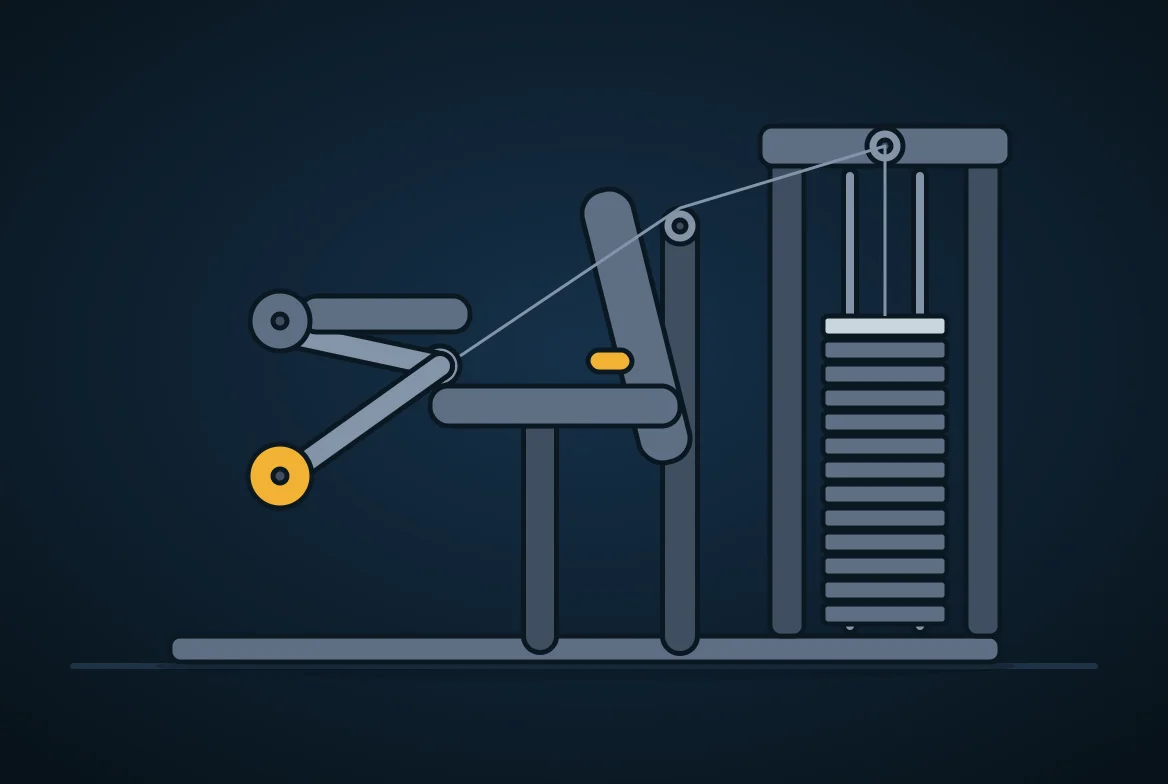
What it works
Your hamstrings, the muscles down the back of your thighs.
How to use it
- Line your knee up with the pivot.
- Thigh pad snug on top, so you can't lift up.
- Curl the pad down and back, then let it up slowly.
- If you've got the choice, pick the seated one.
Common mistakes
- Hips lifting off the bench on the lying version.
- Yanking it.
- Half reps.
A safer swap
Seated, with your back on the pad. The lying version tempts you to arch your lower back.
How to use it
- Line your knee up with the pivot.
- Thigh pad snug on top, so you can't lift up.
- Curl the pad down and back, then let it up slowly.
- If you've got the choice, pick the seated one.
Avoid
- Hips lifting off the bench on the lying version.
- Yanking it.
- Half reps.
A safer swap
Seated, with your back on the pad. The lying version tempts you to arch your lower back.
Did you know?
In a 12-week study, the seated leg curl grew the hamstrings more than the lying one: about 14 per cent against 9.1 The seated position stretches the hamstrings more.
Worth knowing
- Why the stretched position matters: The stretch.
- Its partner: the leg extension.
Sources
Every study and source this page leans on.
1. Maeo S, Huang M, Wu Y, et al. Greater hamstrings muscle hypertrophy but similar damage protection after training at long versus short muscle lengths. Medicine and Science in Sports and Exercise. 2021;53(4):825-837. Link.