There’s no shortage of people telling you exactly how long to train, how many sets, how many days. I’ve tried most of it. Here’s twenty-odd years of me getting it wrong, what I do now, what the research says, and six legends who did it six completely different ways. Then you get a vote.
Before you read
This is my story and what the research says. It isn’t health advice, and it isn’t a programme to copy.
Before you change how you train, especially if you’re new to it, injured, or living with a health condition, get proper advice from your GP or a qualified professional.
How I got it wrong for twenty years
A few days on, lots off. Then twice a day, every day, until my body made me stop.
When I started, there was no rhythm and no reason. I’d go in for a few days, then take several off. I’d throw weights around hopelessly and still come out feeling like I’d done something.
And I had, to be fair. I’d walked through the door. At the start, that’s the achievement.
The Army gave it some shape. Muscle groups, lifts split up, rest built in, and three days off between hitting the same part again. For the first time it was a plan rather than a mood.
Then it turned into something else. Missing a day, or missing a body part, felt like failure. It put me on a downer.
The downer pushed me to do more, the more turned into overtraining, and I pushed through that. The overtraining turned into injuries, and I pushed through those too.
By the end I was training twice a day, six or seven days a week. The staff stopped saying hello and started asking if I needed my own key.
Then everything ached, all the time, and I burnt out completely. That cost me months off to recover. Months. All that effort to avoid missing a day, and I missed a season.
Sets and reps went the same way:
- At first: six heavy reps, with hardly any warm-up.
- Then: four sets of twelve, religiously, whatever the exercise, whatever the day.
So did my time in the gym:
- At first: a couple of hours, bimbling from machine to machine. A set on the chest press, a sit down, a long read of the instructions on the leg extension like it was flat-pack furniture, then a wander over to the dumbbells to see if anyone was watching. Two hours in the building. About eleven minutes of it was exercise.
- Then: an intensive schedule, 30 seconds’ rest between sets, and move on.
Every one of those phases felt right while I was in it. That’s the trap.
What I do now
45 minutes, a muscle to exhaustion, three days off for it. It works for me.
Now I don’t even count reps. I work a muscle until I feel I’ve reached exhaustion and genuinely pushed it, then that body part gets three days off. 45 minutes in the gym, maximum.
Hard and fast, hitting exactly what I want to work, in an order that makes sense. For most people, about 48 hours is enough (see muscle recovery). This is just what I do.
My body isn’t what it was. I get told I look great. I’m past forty, I don’t feel it, and there are other things I live with that I won’t go into.
I do enough to stay on top of all of it, and I walk out feeling I’ve done enough. That last part matters more than any number.
It works for me. I don’t expect it to work for you. Which is the whole point of the rest of this page.
Signs you’re doing too much
When the aching won’t clear, sleep goes, and the weights start going backwards.
There’s a difference between being tired from training and being worn down by it. Sports scientists split it in two.
Pushing hard for a while and feeling flat for a few days, then bouncing back stronger, is normal.
Push past that for weeks without enough rest and you can end up with what they call overtraining syndrome, where performance keeps dropping, and getting it back can take months.1 That was me.
Signs it might be you:
- Your lifts are going backwards even though you’re training as hard as ever.
- The aching doesn’t clear between sessions, and rest days don’t fix it.
- You’re sleeping badly, or waking up tired.
- You’re irritable, low, or dreading the gym you used to love.
- You keep picking up colds, or niggles that won’t settle.
- You feel guilty or anxious about missing a session.
That last one isn’t in most lists, but it was the first sign for me, years before the injuries. Nobody has ever grown an inch because they skipped a rest day out of guilt. I looked into it.
I was hoping it was me. If you recognise several of these, the answer is usually less, not more: a lighter week, more sleep, more food. If it doesn’t lift, or you’re in pain, see your GP.
What the research says
More isn’t always better, and nobody’s found a magic 45 minutes.
The research doesn’t crown a winner, but it does settle a few arguments.
- More sets build more muscle, up to a point. Pooled studies found that doing ten or more hard sets per muscle each week built more muscle than doing fewer than five. The returns shrink as you go higher, and nobody grows from sets they can’t recover from.2
- How you spread them matters less than you’d think. When the total number of sets is the same, training a muscle once a week or more often makes little difference to growth. So a body-part split and full-body sessions can both work.3
- You don’t have to go all the way to failure. Stopping a rep or two short builds about as much muscle as grinding out the last impossible one, and it’s easier to recover from.4
- Short rests aren’t a badge of honour. In trained men, resting about three minutes between sets built more strength and muscle than resting one minute.5 My 30-second years weren’t as clever as I thought. How long to rest between sets has the full answer for beginners.
- There’s no good evidence for a 45-minute cut-off. What counts is how many hard sets you do and whether you recover from them. The clock on the gym wall has no idea how hard you worked. It just knows you’ve been there a while, like the bloke on the bench who’s been “resting” since Tuesday.
And if you just want to be fit and healthy, the NHS asks for muscle-strengthening work on at least two days a week, hitting all the major muscle groups, on top of being active through the week.6 That’s the floor, and it’s lower than most people think.
How the greats did it
From one set a week to forty sets a session. All of them worked, for them.
Six men who reached the very top, and six completely different answers. If there were one right way, they’d all have found it.
Mike Mentzer
One set to failure. Then days off.
Mentzer called his system Heavy Duty. One or two sets per exercise, taken to the point where another rep is impossible, and only four to six sets for a muscle in total. Then rest. Four to seven days before training that muscle again, and he pushed people to rest even longer as they got stronger.7 His argument was that the training is only the signal. The growing happens while you recover, and most people never let it. Think of a cake in the oven. Keep opening the door to check on it and it sinks. Mentzer put the cake in and walked away for a week.
If this is you: Rest and recovery Heavy or light? Form comes first

Dorian Yates
Short, brutal, done.
Six-time Mr Olympia, trained in a bare basement gym in Birmingham. A warm-up set or two, then one all-out set to failure on each exercise, four or five exercises for a muscle. Four sessions a week, each muscle once a week, and a day off after the big ones. Sessions of around 30 to 45 minutes.8 If you thought 45 minutes was soft, the most dominant physique of the 1990s was built in it.
If this is you: Mind on the muscle Lift it, don’t launch it Lifting tempo

Lee Priest
Train with your mates. Stop when you’re done.
Priest thinks the 45-minute rule is nonsense, and said so to Brian Shaw in October 2026: “Lately now, the latest thing is anything over 45 minutes, you’re overtraining and doing too much.” His own sessions were lifting with friends, pushing hard and enjoying it: “If it goes an hour goes, two hours, I don’t care if it went three hours some days.” To be fair to him, he also said shorter, intense sessions can work for someone who has already built a lot of muscle.9
His sessions sound less like a workout and more like a night out where the drinks are weights. And here’s the point people miss: if that’s what keeps you coming back for thirty years, it’s a better programme than a perfect one you quit in March.
If this is you: Bring a mate Gym etiquette

Ronnie Coleman
Heavy, and lots of it.
Eight-time Mr Olympia. Six days a week, Sunday off, with a split that came round twice, heavy compound lifts and a lot of sets.10 He made enormous weights look like warm-ups, and he has since had a long run of operations on his back and hips. I won’t pretend to know what he’d change. That’s his to say.
If this is you: STOP: read this first Weight jumps Lifting standards
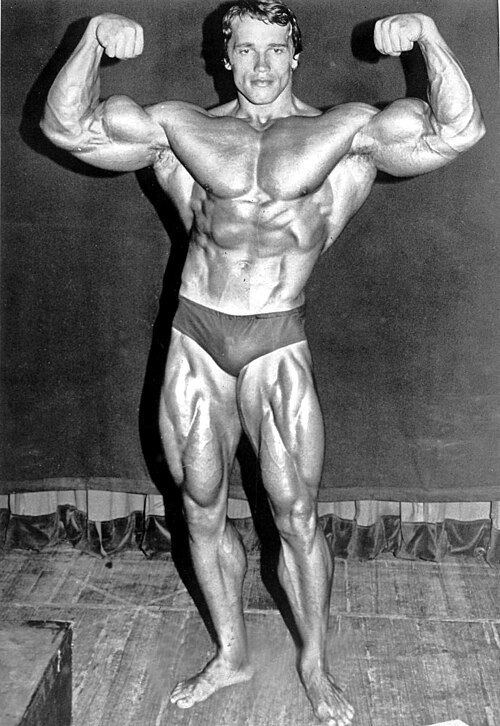
Arnold Schwarzenegger
Twice a day, six days a week.
The man most people picture when they hear the word bodybuilder practically lived in the gym. Twice a day, six days a week, big supersets, and rests often under a minute.11
It built one of the most famous bodies in history. It also took the whole of his life at the time.
He didn’t have to be at work for eight, pick the kids up at three, or explain to anyone why he was off to the gym again before tea.
If your life has any of those in it, his programme was built for a different life.
If this is you: The stretch Rest and recovery
Tom Platz
The Quadfather. Utterly mental, and he meant every rep.
Platz built the most famous legs in bodybuilding, and his leg sessions went beyond anything on this page.
Forty-plus sets, everything taken to failure and then past it, with drop sets, forced reps and rest-pause.
Some of the time he only trained legs this hard twice a month, because a session like that takes that long to come back from.12
He did more leg sets in an afternoon than most people manage in a year, then presumably lived downstairs for a fortnight. That fortnight was the programme too. He treated it as a battle of will as much as muscle.
In 1992, at a fitness expo in Germany, he faced Fred Hatfield, a powerlifter so good at squatting he was known as Dr Squat, in a squat-off.
Hatfield lifted the heavier single, 855 lb to Platz’s 765. Then both took 525 lb for as many reps as they could. Hatfield got 11. Platz got 23.13 I’m not here to mock any of it.
I couldn’t do one session of it, and neither could almost anyone reading this.
If this is you: Leg press When a rep fails Hack squat
Two things all six had that most of us don’t. Genetics: the frame, the recovery and the ability to build muscle that put them in the top fraction of one per cent before they lifted a thing. And, for some of them, help. Arnold and Yates have both said openly that they used steroids, and drugs like that change how much training a body can recover from. There’s more on that in Steroids: the real story. It doesn’t take anything away from how hard they worked. It just means their recovery isn’t yours.
Which way do you think is best?
Pick one. See what everyone else picked.
Have a think about which of these sounds like you, then cast your vote. Each one has links to the pages on this site that suit that way of training.
Pick the one closest to how you’d train. Then see what everyone else picked.
My answer? The best way is the one you’ll still be doing in five years, that you recover from, and that you leave the gym glad you did. For most people that’s nearer Yates than Arnold, and nearer the middle than Platz.
If you just want to keep fit
Structure, sorted food and a bit of logic beat all of the above.
If you’re training to keep fit, a routine with structure, food you’ve got sorted, and some logic behind it is going to work. Not the hours. The plan.
- Pick a number of days you can keep up every week, not just the good weeks.
- Hit every major muscle group across the week.
- Give a muscle time to recover before you train it hard again.
- Rest long enough between sets that the next one is a proper set.
- Sleep and eat like it matters, because that’s where the training turns into results.
If you want something ready-made, your first gym routine is two days a week and done.
If you want to compete, I can’t comment. I defer to the greats above, and to the people who coach at that level.
The cheque your brain writes
Your brain keeps writing cheques. One day your body stops cashing them.
I don’t think my genetics are half bad. But we all have limits, and age has a way of pointing them out. Somewhere along the line, your brain will write a cheque your arse can no longer cash.
Mine started bouncing a while back. I’d train like I was 22, and the next morning my body would send a letter from its solicitor.
That isn’t a reason to stop. It’s a reason to train smarter: less ego, more recovery, warm-ups you used to skip, and the humility to have a lighter day when your body asks for one.
The aim now isn’t to train like I’m 25. It’s to still be training at 75.
There’s more on that in Getting older: a reason, not an excuse.
Sources
Every study and report this page leans on.
1. Meeusen R, Duclos M, Foster C, et al. Prevention, diagnosis and treatment of the overtraining syndrome: joint consensus statement of the European College of Sport Science and the American College of Sports Medicine. Medicine and Science in Sports and Exercise. 2013;45(1):186-205. Link.
2. Schoenfeld BJ, Ogborn D, Krieger JW. Dose-response relationship between weekly resistance training volume and increases in muscle mass: a systematic review and meta-analysis. Journal of Sports Sciences. 2017;35(11):1073-1082. Link.
3. Schoenfeld BJ, Grgic J, Krieger J. How many times per week should a muscle be trained to maximize muscle hypertrophy? A systematic review and meta-analysis. Journal of Sports Sciences. 2019;37(11):1286-1295. Link.
4. Grgic J, Schoenfeld BJ, Orazem J, Sabol F. Effects of resistance training performed to repetition failure or non-failure on muscular strength and hypertrophy: a systematic review and meta-analysis. Journal of Sport and Health Science. 2022;11(2):202-211. Link.
5. Schoenfeld BJ, Pope ZK, Benik FM, et al. Longer interset rest periods enhance muscle strength and hypertrophy in resistance-trained men. Journal of Strength and Conditioning Research. 2016;30(7):1805-1812. Link.
6. NHS. Physical activity guidelines for adults aged 19 to 64. Link.
7. Mike Mentzer was ahead of the science. Heavy Duty: sets, failure and rest between workouts. Link.
8. Fitness Volt. Dorian Yates’ HIT (high-intensity training): how he trained. Link.
9. Sport Manual. Lee Priest tells Brian Shaw why he believes limiting workouts to 45 minutes is nonsense. 8 October 2026. Link.
10. Fitness Volt. Ronnie Coleman’s high-volume bodybuilding split. Link.
11. T3. Arnold Schwarzenegger’s high-volume training approach explained. Link.
12. Lift Big Eat Big. Tom Platz: the Quadfather who proved leg training is about willpower, mentality and complete exhaustion. Link.
13. BarBend. The story behind the Great American Squat-Off (Platz and Hatfield, FIBO, Essen, 1992). Link.
Photo credits
Who took the photos, and the licence each is used under.
Arnold Schwarzenegger in 1974. Photo: Madison Square Garden Center, Public domain, via Wikimedia Commons.
Dorian Yates. Photo: Beaverino, CC BY-SA 4.0, via Wikimedia Commons.
Ronnie Coleman at FIBO in 2014. Photo: Health Gauge, CC BY 2.0, via Wikimedia Commons.
Lee Priest in 2024. Photo: Sam's Fitness - Gym Equipment, CC BY 3.0, via Wikimedia Commons.