Bathroom scales are a useful tool with the personality of a wind-up merchant. Here's how to use them without letting them use you.
The lie
"The scales don't lie."
The short version
- Your weight can go up and down by a kilo or more from day to day. That's mostly water, salt and food, not fat.
- Weigh once a month: same morning, same conditions.
- Measure progress in other ways too: your belt, your clothes, the stairs.
Today's rep: Name your scales. Jump to it
Meet the Doctor
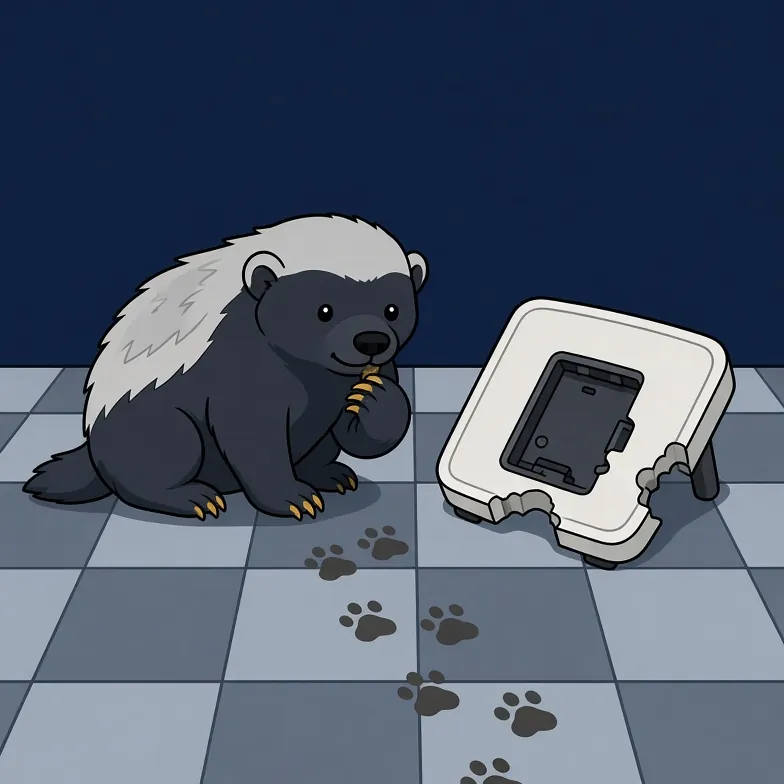
Meet Dr Shamington the Third of Brunswick. He lives on your bathroom floor. He went to a very expensive school, learned nothing, and has opinions about you.
On Monday he tells you you've put on two pounds. You haven't. You had a salty curry and he knows it.
On Thursday, after a hot day and a long walk, he tells you you're a Greek god. You aren't. You're thirsty.
He's wrong in both directions, often before breakfast. So we don't take his word for anything, and he only gets to speak once a month.
Give yours a name. Something you'd never trust with your car keys. When the number's bad, it isn't your verdict. It's just the Doctor, being the Doctor.
Name your scales
The name is saved on this device only. Nobody else sees it.
Why the number wobbles
"The scales don't lie" is said with great confidence by people who have clearly never stood on them twice in one day. Your weight isn't a fixed number. It sloshes about through the day and across the week with water, salt, what you've eaten, and what you've eaten but haven't yet formally said goodbye to. Studies that track people's weight find it tends to creep up over the weekend and drift back down during the week.1 A salty takeaway can hold an extra bit of water overnight. A hot day can take it off again. None of that is fat. All of it is the Doctor having a field day.
Mostly for women
Men, the Doctor only lies to you for the reasons above. You can skip ahead.
Your cycle, and the Doctor
Dr Shamington knows exactly when your period is due. He has never once mentioned it. He just adds a kilo and waits for your reaction.
Fluid retention changes across the menstrual cycle. In a study that followed 62 women for a year, retention peaked on the first day of their period and was lowest in the week or so after it ended.2 None of that is fat. It's the Doctor, being the Doctor, with an extra excuse.
So weigh at the same point in your cycle each month (the week after your period is a good choice), and compare month to month, never week to week.
Once a month. Same rules.
Same morning, same floor, same scales. Then put him back under the sink.
Weighing yourself does help some people. Reviews of the research link regular self-weighing with better weight loss, so I'm not saying scales are evil.3 I'm saying if every wobble ruins your morning, the daily number is costing you more than it's telling you. So in Bootcamp, the Doctor speaks once a month, and he's lucky to get that.
- Same day each month. Put it in your phone calendar.
- First thing in the morning, after the toilet, before you eat or drink.
- Same scales, on the same hard floor. Scales on carpet make things up, like a man in a pub who's been to Spain once.
- Same clothes, or none. Your call. The Doctor has seen worse.
- Write the number down. Then put him back under the sink, facing the wall.
Better ways to measure
Your belt has never once had an opinion about curry.
- Your belt. Which notch? It's the most honest object in your house and it has never once had an opinion about curry.
- One tight pair of trousers. Try them on once a month. No sucking in. The trousers know.
- A tape measure round your waist at belly button level, once a month.
- The stairs test. How many flights before you're puffing?
- The talk test. Can you walk briskly and still hold a conversation?4
- Everyday life. How you sleep, how you feel at 3pm, and whether you can carry all the shopping in from the car in one trip, which some heroes already insist on doing, at great cost to their fingers.
Progress photos work for some people. If the mirror chapter sounded a bit familiar, skip them. A tape measure doesn't have opinions, and it went to a perfectly ordinary school.
Why naming him works
Give the number a name and it stops being a verdict on you.
Giving the scales a daft name isn't only a joke. Therapists use a similar idea called externalising: you treat a problem as something outside you, with its own name, rather than something you are.5 The number becomes the Doctor's opinion. Not your worth.
Your rep for this chapter
Name your scales. Put them away. Set a monthly reminder on your phone for weigh-in day. Check on the Doctor occasionally. He's had a rough morning.
The lie: "The scales don't lie."
The short version
- Your weight can go up and down by a kilo or more from day to day. That's mostly water, salt and food, not fat.
- Weigh once a month: same morning, same conditions.
- Measure progress in other ways too: your belt, your clothes, the stairs.
Your rep
Name your scales. Put them away. Set a monthly reminder on your phone for weigh-in day. Check on the Doctor occasionally. He's had a rough morning.
Your browser forgets. Your photos don't. Save it, and the rep turns up in your camera roll at 7am when you're looking for something else.
Sources
1. Orsama AL, Mattila E, Ermes M, van Gils M, Wansink B, Korhonen I. Weight rhythms: weight increases during weekends and decreases during weekdays. Obesity Facts. 2014;7(1):36-47.
2. White CP, Hitchcock CL, Vigna YM, Prior JC. Fluid retention over the menstrual cycle: 1-year data from the Prospective Ovulation Cohort. Obstetrics and Gynecology International. 2011;2011:138451.
3. Zheng Y, Klem ML, Sereika SM, Danford CA, Ewing LJ, Burke LE. Self-weighing in weight management: a systematic literature review. Obesity. 2015;23(2):256-265.
4. NHS. Walking for health.
5. White M, Epston D. Narrative Means to Therapeutic Ends. W. W. Norton; 1990.